New York, NY 10017

7 Signs Your Marble Floors Need Professional Restoration Before Permanent Damage Occurs
Your marble might look clean and still be in serious trouble. Here are the warning signs most homeowners miss until it's too late.
Share:

Summary:
Here’s something most marble owners don’t realize: cleaning your marble and caring for your marble are two completely different things. You can mop, wipe, and polish every week and still be watching your floors quietly deteriorate beneath the surface. Etching, micro-scratches, and subsurface staining have nothing to do with dirt — which means no amount of cleaning will fix them. If your marble has been looking a little off lately and you can’t figure out why, this guide is for you. We’ll walk you through the seven signs that tell you professional restoration is needed before the damage crosses the line from fixable to permanent.
Why Marble Damage Is Easy to Miss Until It's Too Late
Marble is a beautiful surface, but it’s also a surprisingly vulnerable one. It’s composed primarily of calcium carbonate, which reacts chemically when it comes into contact with acids — think lemon juice, vinegar, wine, or even certain cleaning products. That reaction doesn’t leave a stain you can wipe away. It dissolves a microscopic layer of the stone itself, leaving behind a dull, rough patch called an etch mark. Most homeowners spend months trying to clean it before realizing cleaning isn’t the answer.
The other challenge is that marble is relatively soft compared to granite, which means scratches accumulate from everyday life — furniture legs, grit tracked in from outside, hard-soled shoes. Each individual scratch seems minor. Over time, they add up into a surface that looks worn and tired even when it’s technically clean.
The 7 Warning Signs Your Marble Needs Professional Restoration
**Sign 1: Persistent dullness that won’t respond to cleaning.** If your marble floors or countertops have lost their shine and no product seems to bring it back, you’re almost certainly looking at etching — chemical damage to the stone’s surface layer. This isn’t a cleaning problem. It’s a structural one, and it requires mechanical restoration with professional-grade diamond abrasives to correct.
**Sign 2: Cloudy or white patches that appeared after contact with a liquid.** Lemon juice squeezed near the counter, a splash of wine, a cleaning spray with acidic ingredients — any of these can leave behind a hazy, frosted-looking spot. Many homeowners mistake these for stains and scrub harder, which does nothing. The surface has been chemically altered, and the only fix is professional honing or polishing to remove the damaged layer.
**Sign 3: Visible scratches across the surface.** Light surface scratches from everyday foot traffic or furniture movement can often be addressed with marble polishing. Deeper scratches — the kind that catch your fingernail — typically require honing, where progressively finer diamond abrasives resurface the stone. Either way, leaving scratches untreated means they deepen over time as grit and debris work their way into the grooves.
**Sign 4: Staining that won’t budge.** As marble ages, it becomes more porous, and liquids like oil, coffee, rust, and red wine can penetrate below the surface where household cleaners can’t reach. We can draw the stain out using poultices and specialized treatments — but the longer a stain sits, the harder it becomes to remove completely.
**Sign 5: Uneven shine across the floor.** Some areas glossy, others flat — this is a classic indicator of differential wear, usually from high-traffic patterns. The solution isn’t to polish the dull spots in isolation; it’s to restore the entire surface to a consistent finish, which requires a full professional refinishing pass.
**Sign 6: Chips or cracks, even small ones.** A chipped edge on a marble threshold or a hairline crack in a bathroom floor might seem cosmetic, but cracks allow moisture to penetrate the stone, which accelerates deterioration from the inside out. Professional repair using color-matched epoxy can restore structural integrity and make the damage nearly invisible — but only if it’s addressed before moisture causes the crack to widen.
**Sign 7: You’ve been using the wrong cleaner.** Acidic cleaners, bleach-based products, and even some “natural” cleaners are damaging to marble. If you’ve been using anything other than a pH-neutral stone cleaner, the cumulative damage may already be significant. A professional assessment can tell you exactly where things stand and what it will take to restore the surface.
What Happens If You Wait — The Compounding Cost of Ignored Marble Damage
Marble damage is progressive. A light etch mark that could be addressed with a single polishing visit becomes a deep etch that requires grinding if you ignore it for another year. A surface scratch that a honing pass could have corrected turns into a structural groove that now needs more aggressive diamond work. Each stage of neglect multiplies the scope — and the cost — of the restoration needed.
The financial math is stark. Professional marble restoration in NYC and Long Island typically runs $5 to $25 per square foot depending on the condition and the level of work required. Full marble replacement, by contrast, runs $50 to $150 per square foot — and a bathroom remodel with new marble can easily reach $12,000 to $20,000. In a market where Nassau County median home prices have crossed $840,000, the decision to restore rather than replace isn’t just practical — it’s financially obvious.
There’s also a threshold beyond which restoration becomes significantly more difficult. Most marble damage, even damage that looks severe to a homeowner, is fully reversible when we get to it in time. Deep etching, widespread scratches, stubborn stains, even many cracks — all of these are manageable with the right equipment and technique. But there is a point of no return, and waiting to see if the problem resolves itself on its own is the fastest way to reach it.
We hear often from homeowners in pre-war Manhattan buildings and Long Island colonials alike: “I thought it was ruined.” In almost every case, it wasn’t. But the longer the wait, the closer that line gets.
What Professional Marble Restoration Actually Involves
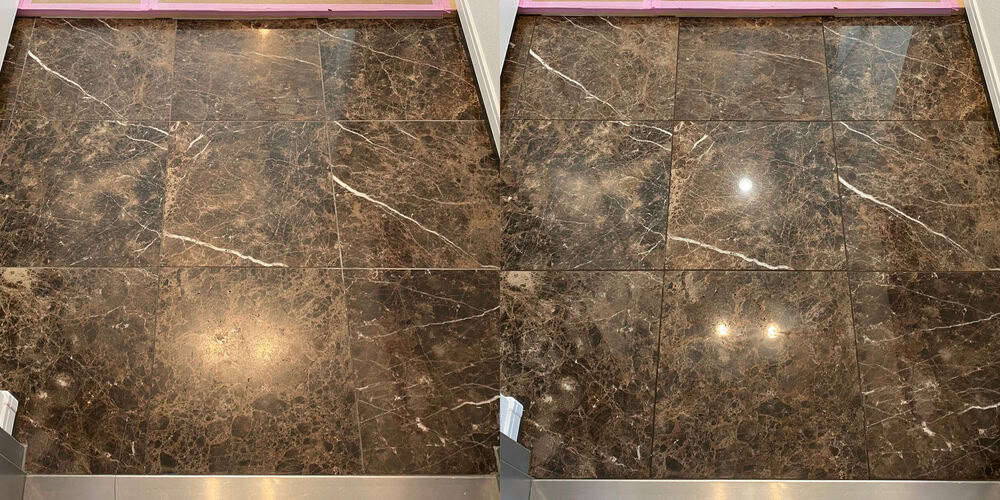
Marble restoration isn’t just polishing. That’s a common misconception, and it leads a lot of homeowners to try a buffing pad or a store-bought kit before calling us — often making things worse in the process. True restoration is a multi-step process: deep cleaning, grinding if the damage is severe, honing with progressively finer diamond abrasives to remove scratches and etch marks, polishing to restore the finish, and sealing to protect the surface going forward.
Each step requires professional-grade equipment and material-specific knowledge. Consumer rental machines and hardware store products can’t replicate what industrial diamonds and color-matched epoxy systems do. Using the wrong method for your specific stone type can cause permanent damage — which brings us to something worth knowing.
Does the Type of Marble You Have Change How It Should Be Restored?
Yes — and this is one of the details that separates a genuine expert from a generalist. Most marble is restored using wet polishing, where water lubricates the surface during refinishing and traps marble shavings in liquid for easy cleanup. It’s effective, it’s dust-free, and it’s the industry standard for the vast majority of marble types.
Dolomitic marble is a notable exception. Wet polishing dolomitic marble can cause a permanent haziness in the surface that cannot be reversed. It requires dry polishing techniques instead — a distinction that most restoration companies never mention because they either don’t know the difference or don’t work with enough stone variety to have encountered it.
This matters for NYC and Long Island homeowners in particular because older buildings often contain marble varieties that were common in late 19th and early 20th century construction — and not all of them are standard calcitic marble. If you’re in a pre-war building on the Upper East Side, a brownstone in Park Slope, or a historic home in Garden City, NY, there’s a real chance your marble has specific characteristics that require a more nuanced approach.
The broader point is that marble restoration isn’t one-size-fits-all. The condition of the stone, its age, its mineral composition, and the nature of the damage all factor into how the work should be done. A professional who asks the right questions before picking up a machine is worth far more than one who shows up with a standard process and applies it regardless.
Does Sealing Marble Protect It From the Damage Described Above?
Partially — and understanding the limitation here is genuinely important. A quality sealer creates a barrier that resists liquid absorption, which means spills are less likely to penetrate the stone and cause staining. That’s real protection, and sealing is a worthwhile part of any marble maintenance routine.
What sealer cannot do is prevent etching. Etching is a chemical reaction between acid and calcium carbonate — it happens at the surface of the stone, not below it. A sealer doesn’t neutralize acid or stop that reaction from occurring. So a sealed marble countertop will still etch if you squeeze a lemon on it and leave the juice sitting there.
This distinction matters for Long Island homeowners in coastal communities especially. Salt air carries mild acidity, and over time, that exposure contributes to surface finish degradation on marble near windows, entryways, and exterior-adjacent spaces — regardless of whether the stone has been sealed. We’ve worked extensively in communities along the South Shore of Nassau County and in waterfront homes across Suffolk County, NY, and coastal conditions are a real factor that accelerates the timeline between installation and the need for professional restoration.
The practical takeaway: sealing is maintenance, not a substitute for restoration. If your marble is already showing signs of etching, dullness, or scratching, sealing it won’t fix those problems. Restoration comes first, sealing comes after, and then you’re protected going forward.
When to Call a Professional for Marble Restoration in NYC and Long Island
If you’ve recognized one or more of the seven signs above, the honest answer is: sooner is better. Not because the situation is necessarily urgent, but because marble damage compounds. What costs $5 to $25 per square foot to restore today will cost significantly more — or require full replacement at $50 to $150 per square foot — if you wait until the damage has progressed past the point where restoration is practical.
Most marble damage is fixable. Deep etching, widespread scratches, stubborn stains, and even many cracks are all within the scope of professional restoration when they’re addressed in time. The goal of this guide wasn’t to alarm you — it was to give you the information you need to make a clear-eyed decision before that window closes.
If you’re in NYC or Long Island and you’re not sure where your marble stands, we’ve been doing this work since 2006. Reach out and let’s take a look.
Article details:
- Published by:
- NYC Stone Care
- Published to:
- Last modified:
- October 12, 2026
Share:
Continue learning: