Serving NYC & Long Island
info@nycstonecare.com
24/7 Availability
Dull, etched, or cracked marble doesn't mean it's done. Find out why so many Manhattan and Long Island homeowners are restoring instead of replacing — and what the process actually involves.
Share:

Summary:
You noticed it gradually — the shine faded, a few etch marks appeared, maybe a crack you’ve been ignoring for months. Now your marble looks tired, and someone gave you a quote to replace it that made your stomach drop. Before you commit to a full renovation, it’s worth knowing that most marble damage is fixable. Not patched-over, not disguised — actually fixed. We’ve been restoring marble across Manhattan, Nassau County, Suffolk County, and Long Island since 2006, and the most common thing we hear after a job is done is some version of: “I had no idea it could look like this again.”
Marble restoration is not cleaning. That distinction matters more than most people realize. Cleaning removes surface dirt. Restoration addresses the actual structure of the stone — the microscopic scratches, etch marks, and wear patterns that make marble look dull or damaged no matter how much you scrub it.
The process involves diamond abrasive systems that work through progressively finer grits to level the surface, remove damage, and bring the stone back to its original finish. After that, a professional-grade penetrating sealer goes on to protect against future staining and moisture. Done correctly, the result isn’t just cleaner marble — it’s marble that looks the way it did when it was first installed, sometimes better.
The first thing we do on any job is assess the stone — what type it is, what kind of damage is present, and what finish you’re after. Marble behaves differently than granite, limestone, or travertine, and even within marble there are meaningful differences depending on the variety. Carrara, Calacatta, and Nero Marquina all have different densities and surface characteristics that affect how they respond to honing and polishing. Skipping this step is one of the main reasons restoration jobs go wrong.
Once we understand the stone, we work through a structured sequence: deep cleaning to remove embedded residue, honing with diamond abrasive pads to eliminate scratches and etch marks, polishing to bring the surface to your desired finish level, crack and chip repair using color-matched two-component epoxy where needed, and finally sealing to protect the restored surface. Grout restoration and caulk replacement happen alongside this when the grout lines have darkened or deteriorated — which is common in older bathrooms and kitchens across Long Island’s mid-century housing stock.
Each step builds on the one before it. Polishing over a surface that hasn’t been properly honed produces uneven results. Sealing a surface that hasn’t been thoroughly cleaned traps residue beneath the sealer. The sequence isn’t arbitrary — it’s what separates a restoration that lasts from one that looks good for a few weeks and then fades back.
For cracks and chips specifically, the two-component epoxy we use is color-matched to the existing stone. On marble with strong natural veining — the kind you see in a lot of Manhattan pre-war buildings and Hamptons kitchens — a well-done repair blends into the pattern so cleanly that it’s effectively invisible. That’s not always possible with every crack, and we’ll tell you honestly what to expect during the assessment. But in most cases, the repair holds up and the surface reads as continuous.
This is something worth saying plainly: not every company offering marble restoration actually knows how to do it. Some are cleaning companies that added “stone restoration” to their service list without the equipment, training, or technique to back it up. The damage that results — uneven surfaces, permanent scratches from wrong-grit abrasives, stone that looks worse after the job than before — is often irreversible.
The difference shows up in our equipment and materials. We use diamond abrasive systems, not sandpaper or generic pads. We use penetrating sealers formulated for natural stone, not consumer products from a hardware store. And we understand how different stone types respond — because what works on granite can destroy marble, and vice versa.
We use eco-friendly products throughout our process, which matters in homes with children and pets. It also matters in the kinds of spaces we work in regularly — Manhattan co-ops and condos where building boards require licensed, insured contractors and where the common areas see heavy foot traffic from residents who live there full-time. The products we use are safe for those environments without compromising results.
If you’re comparing quotes and one comes in significantly lower than the others, it’s worth asking what products they use and whether they can walk you through our process step by step. A company that knows what they’re doing will have no trouble answering that. One that doesn’t will get vague quickly.
Professional marble restoration typically runs $5 to $20 per square foot depending on the condition of the stone and the scope of the work. Full marble replacement — once you factor in demolition, fabrication, and installation — costs $50 to $150 per square foot. For a Long Island kitchen or master bathroom with 150 square feet of marble, that’s a difference between roughly $750–$3,000 for restoration versus $7,500–$22,500 for replacement. That gap is hard to ignore.
The savings aren’t just about the upfront cost. In a market where Nassau County’s median home price has crossed $840,000 and Long Island luxury properties are trading at record highs, the condition of your stone surfaces has a direct effect on how buyers perceive your home. Restoration preserves that value without the disruption, timeline, or cost of a full renovation.
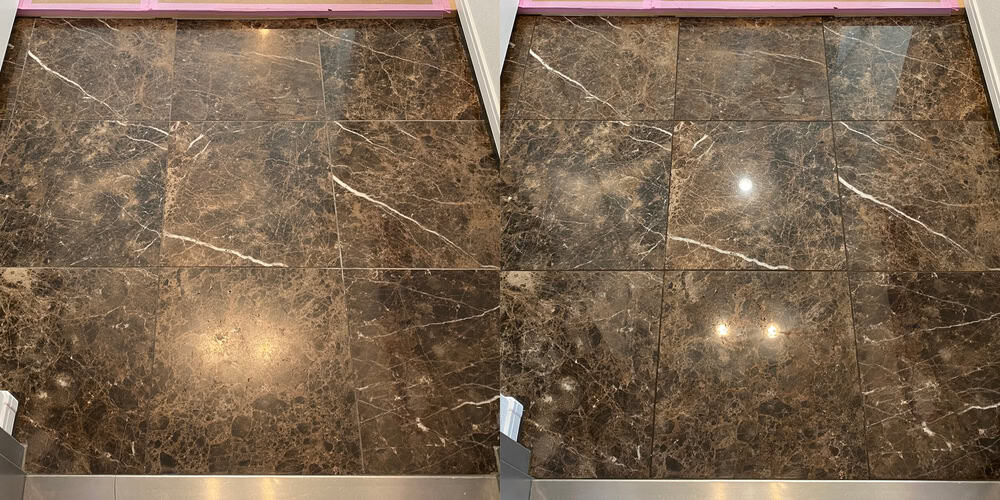
For most homeowners in Manhattan and Long Island, restoration is the right call — not because replacement is never appropriate, but because the situations that genuinely require it are rarer than people think. A crack doesn’t require a new slab. Etch marks don’t require new tile. Dullness that’s accumulated over years of use is almost always reversible with the right process.
There’s also a preservation argument that’s specific to this market. A lot of Manhattan’s pre-war buildings — the co-ops and condominiums built in the 1920s through 1950s — have original Italian marble in their lobbies, bathrooms, and staircases. Some of that marble came from quarries that are no longer in operation. You can’t replace it with a match. You can only restore what’s there, and doing that well requires someone who understands the material.
The same logic applies in parts of Nassau and Suffolk County where mid-century homes still have their original marble installations — now 50 to 70 years old and showing the wear that comes with it. Replacing that stone often means settling for something that doesn’t quite match the rest of the home. Restoring it means keeping what’s already there and making it look the way it should.
For homeowners preparing to sell, the calculus is even clearer. A marble restoration project that costs $2,000 to $4,000 can meaningfully shift how buyers perceive a kitchen or master bath — and in a market moving the way Long Island’s is right now, that perception translates into real dollars. Research from the National Trust for Historic Preservation suggests that maintaining original stone architecture can increase property value by up to 18% compared to full renovation. That’s not a small number when the median sale price in Nassau County is pushing $1.1 million.
The question we hear most often is some version of: “Is my marble too far gone to be saved?” The honest answer is that most marble — even stone that looks severely damaged — can be restored to a condition that surprises homeowners. The cases where restoration genuinely can’t deliver a good result are less common than people assume, and we’ll tell you upfront during the assessment if you’re in one of them.
People also ask how long the results last. A professionally restored and sealed marble surface can hold up for years with proper care. The main variables are foot traffic, what cleaning products are used on it afterward, and whether it gets resealed on schedule — roughly every six to twelve months for marble and limestone. We offer ongoing maintenance programs for exactly this reason. Restoration is the reset; maintenance is what keeps it there.
Another question that comes up often, especially from homeowners in Nassau and Suffolk Counties who’ve dealt with hard water for years: “Can you remove mineral deposits and water stains from my shower marble?” Yes — that cloudy, etched look that builds up on marble shower walls from Long Island’s moderately hard tap water is one of the most common things we address. It’s not permanent damage. It’s surface-level accumulation that responds well to professional treatment.
And for homeowners in Manhattan co-ops and condos: yes, we work in those buildings regularly. We understand the requirements — licensed and insured contractors, clean job sites, minimal disruption to other residents. We’ve worked with building boards, property managers, and interior designers across the city for nearly two decades, and that experience shows in how we approach a job from the first call to the final walkthrough.
The difference between a restoration job that transforms your stone and one that leaves you frustrated usually comes down to two things: the skill of the people doing the work and the honesty of the conversation before it starts. You want a company that assesses your stone carefully, explains what they’re going to do and why, and gives you a clear picture of what to expect — not one that overpromises and figures out the details later.
We’ve been doing this work across Manhattan, Nassau County, Suffolk County, and Long Island since 2006. The projects we’re most proud of are the ones where a homeowner came in expecting to replace everything and left with restored marble that looked better than they thought possible.
If your marble is looking worn and you’re not sure whether restoration or replacement makes more sense for your situation, we’re a good place to start that conversation. Get in touch, and we’ll assess your stone and walk you through what’s possible.
Article details:
Share:
Continue learning:
The Complete Guide to Stone Sealing in Manhattan & Long Island — What Type, When, and Why It Matters