Serving NYC & Long Island
info@nycstonecare.com
24/7 Availability
Before you call a countertop showroom, read this. Your stone may not need replacing; it may just need the right hands.
Share:
Summary:
You have been staring at that countertop for weeks. Maybe it is a dull patch that will not clean up no matter what product you use. Maybe there is a chip near the sink, or a faint crack you noticed after a heavy pot landed wrong. Whatever the issue, your first instinct might be to start pricing out new slabs.
Before doing that, stop. Most stone damage that looks permanent is not. In a market like Manhattan, Nassau County, or Suffolk County, where full countertop replacement can easily run into five figures once you factor in demolition, fabrication, and reinstallation, knowing the difference between a restoration job and a replacement job is worth a substantial amount of money.
Here are the seven signs your stone countertop needs restoration, not a full replacement.
Stone restoration is a multi-step professional process: cleaning, honing, polishing, and sealing. It is designed to return your stone surface to something close to its original factory finish. It is not a deep clean. It is not a DIY polish kit from a home improvement store. And it is definitely not something a general cleaning company can replicate by showing up with standard products.
Honing removes scratches and etch marks by working through the surface layer of the stone. Polishing brings back the natural gloss. Sealing creates a protective barrier that slows down future damage. Each step matters, and the specific sequence matters. When completed correctly using professional-grade tools, the proper technique for your stone type, and a technician who understands the difference between marble and granite, the results can be genuinely striking.
This is where a lot of homeowners, and frankly a lot of contractors, make costly mistakes. Marble and granite are not interchangeable. Limestone behaves differently from travertine. What works on one natural stone can ruin another.
Marble is a softer, more porous stone. It etches easily when it comes into contact with acidic substances: lemon juice, wine, vinegar, and even common household cleaners. That etching is not a surface stain you can wipe away. It represents real chemical damage to the surface of the stone, requiring mechanical honing to correct. Trying to scrub it clean will never work, no matter how hard you scrub.
Granite is denser and more resistant to etching, but it is not invincible. It can scratch, chip, and develop cracks, especially along edges and seams. Despite its reputation for durability, granite still needs regular sealing. A compromised seal is one of the most common reasons granite countertops start absorbing liquid stains.
Limestone, particularly the French limestone found in many Manhattan apartments, is softer than both granite and marble. It chips more easily, especially near high-traffic areas like sinks and cooktops. It requires a careful, material-specific approach that a generalist simply will not know how to apply.
The point is straightforward: whoever works on your stone needs to understand the exact material before touching it. Using the wrong abrasive, the wrong chemical, or the wrong technique on a specific stone can cause damage far worse than what you started with. That scenario is not hypothetical; it happens frequently when homeowners hire a general cleaning company that dabbles in stone rather than a team that works with natural stone exclusively.
How do you know when it is time to call a professional? Here are the seven signs that restoration, rather than complete replacement, is what your countertop needs.
The first is dullness that will not clean up. If your marble or granite countertop has lost its shine and no amount of cleaning brings it back, that issue is almost always surface etching or micro-scratching, not dirt. Cleaning the surface will not fix it because the problem lives in the stone surface, not on top of it. This is one of the most common issues we see across Long Island kitchens and Manhattan apartments, and it is one of the most straightforward problems professional restoration addresses.
The second is visible etch marks. These show up as lighter, matte patches (frequently ring-shaped) on marble surfaces. They are the result of acidic contact and are frequently mistaken for simple water spots. They are not spots, so no cleaner will remove them, but diamond honing will.
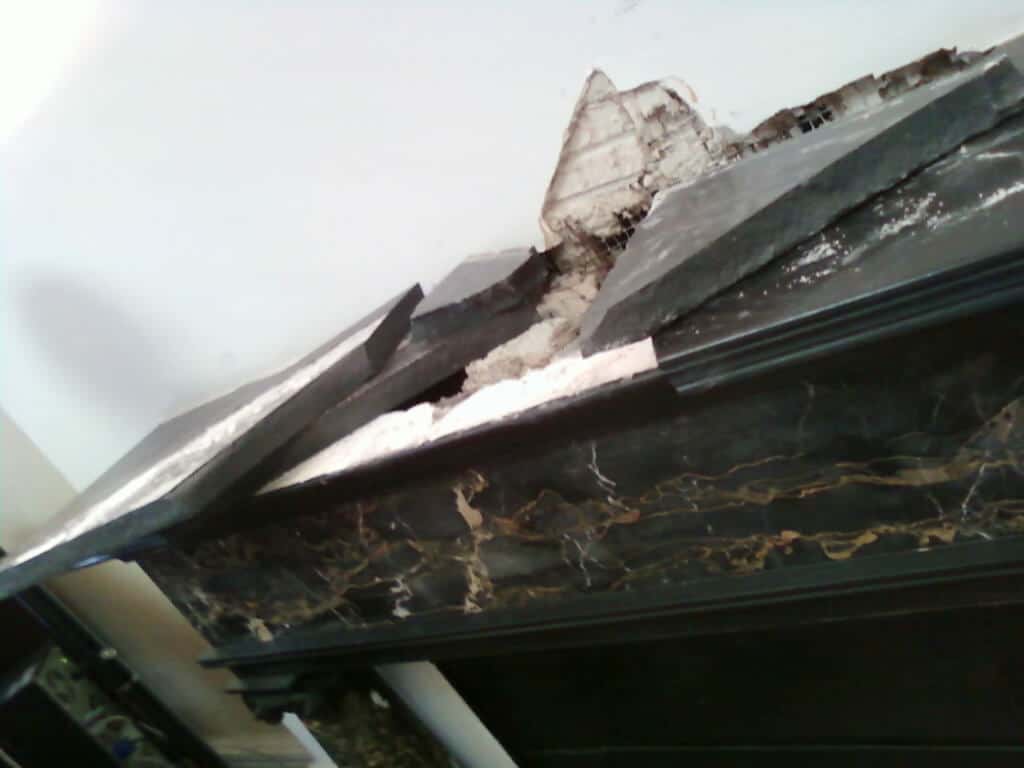
The third is chips along edges or near the sink. Soft stones like marble and limestone chip more easily than people expect, particularly around cutouts and edges where structural support is lower. In SoHo kitchens featuring Carrara or Calacatta marble, this damage is especially common. A quality chip repair uses color-matched epoxy mixed to match the stone’s specific pattern. When executed well, you cannot tell the stone was ever damaged.
The fourth is surface scratches. Light scratches from cookware, utensils, or abrasive cleaners are fully restorable. Deep gouges penetrating deep into the stone may require a specialized assessment, but in most cases, professional honing can eliminate or significantly reduce scratch visibility.
The fifth is recurring staining, even after sealing. If you have sealed your countertop and stains keep penetrating the surface, the seal has likely failed, or the wrong sealant was selected for your stone type. This is a fixable problem. Professional restoration includes applying the correct sealant formulation for your specific stone, which makes a major difference in how long the protection holds up.
The sixth is a crack or fracture. This issue understandably makes homeowners nervous. However, not all cracks mean the slab is structurally compromised. Hairline cracks and minor surface fractures can often be stabilized and filled with color-matched resin, rendering them nearly invisible and preventing further spread. The time to address a crack is before it grows, not after.
The seventh is stone that is simply aging. Long Island’s housing stock includes a large number of homes renovated during the 1990s and early 2000s, meaning many stone countertops in Nassau County and Suffolk County are now 20 to 30 years old. After decades of use, even well-maintained stone accumulates micro-damage that dulls the surface and breaks down the seal. Professional restoration, which is typically recommended every two to three years for high-use surfaces, can bring aging stone back to a condition that routinely surprises homeowners.
This detail tends to change the conversation quickly. When homeowners think about replacing a countertop, they often consider only the retail price of the new slab. However, the slab is just one component of a much larger total cost.
A full countertop replacement in Manhattan, Nassau County, or Suffolk County involves demolition, debris haul-away, template fabrication, custom cutting, edge profiling, and installation labor, along with plumbing reconnection for the sink. When adding up those individual expenses, a replacement project that began as a simple swap routinely turns into a $10,000 to $15,000 investment. Professional stone restoration costs a small fraction of that total.
For residents in a Manhattan co-op or condo, full countertop replacement is not just expensive; it is logistically complicated in ways that restoration is not.
Most Manhattan residential buildings require board approval for renovation work. Strict regulations typically govern contractor hours (often limited to weekday mornings), noise levels, and protection requirements for common areas during material delivery and removal. Transporting a heavy new slab into a pre-war building elevator, through narrow hallways, and into a kitchen without causing damage is a major operation. Additionally, if your building features original marble floors in the lobby or entryways, as many pre-war Manhattan buildings do, those historic surfaces are virtually irreplaceable. Matching aged stone is rarely possible, making professional restoration the most practical path forward.
Professional stone restoration sidesteps these logistical headaches entirely. Most projects wrap up in four to eight hours. The job requires no demolition, no bulky material deliveries, no municipal permits, and no extended disruption to your daily routine. For Manhattan residents who have managed building logistics in the past, that convenience often matters as much as the financial savings.
The same logic applies to Suffolk County homeowners managing seasonal properties on the East End. When prepping a Hamptons property for the summer season, work needs to be completed quickly and correctly before guests arrive. Restoration offers the most practical answer for those timelines as well.
This risk is worth addressing directly because improper stone care can lead to serious, lasting damage.
Natural stone can be compromised by an inexperienced operator. Cleaning companies offering stone polishing as a side service frequently use abrasives or acidic products that are entirely unsuitable for the specific stone type. A harsh abrasive on marble will add new scratches. An acid-based cleaner on limestone will etch and strip the surface finish. Similarly, a retail DIY polishing kit applied incorrectly can create additional problems on top of the original damage.
We regularly hear from homeowners who attempted to fix a dull patch or chip themselves, only to end up with a surface that looks worse than before. While consumer products are marketed as universal solutions, retail instructions rarely explain material nuances clearly. Once you identify any of the seven signs outlined above, selecting the right professional is the critical next step.
The key question to ask any service provider is simple: do they work exclusively with natural stone, or is restoration just an add-on to other services? A team that restores natural stone every single day across marble, granite, limestone, travertine, and terrazzo will treat your countertop with a level of precision that generalists cannot match. The specialized equipment, formulations, and real-time judgment calls required during a job come only from dedicated, long-term experience across diverse stone types and damage scenarios.
For homeowners in Nassau County, Suffolk County, and across Long Island, this distinction is crucial. Your stone surfaces represent a real investment, and fixing someone else’s mistake almost always costs more than getting the job done right from the start.
If you recognized your countertop in any of the seven signs above (whether it is persistent dullness, etch marks, edge chips, recurring stains, or a hairline crack), the surface can likely be restored. It is worth evaluating your options before pricing out replacement slabs.
Most stone damage that appears permanent can be reversed. Success requires a specialist who understands natural materials, utilizes professional equipment, and possesses the experience to address your specific surface issues. That level of care is fundamentally different from what a general contractor or standard cleaning service provides, and the distinction shows in the final result.
NYC Stone Care has been restoring natural stone surfaces across Manhattan, Nassau County, and Suffolk County for nearly 15 years. If you want to evaluate your options or see if restoration makes sense for your countertop, reach out to our team today. Getting a clear, honest answer costs nothing and can save you a significant amount of money.
Article details:
Share:
Continue learning: