Serving NYC & Long Island
info@nycstonecare.com
24/7 Availability
NYC marble gets damaged fast — here's what's actually causing it and what professional repair looks like when it's done right.
Share:
Summary:
Marble is everywhere in New York City — in Park Avenue lobbies, SoHo loft kitchens, pre-war bathroom floors, and Midtown hotel entryways. It’s one of the reasons these spaces look the way they do. But marble is also softer than most people expect, and New York is not a gentle environment for it. Salt, spills, grit, vibration, and years of improper cleaning all leave their mark. If your marble looks dull, cloudy, scratched, or cracked, you’re not alone — and the damage is almost always fixable without tearing anything out. Here’s what you’re actually looking at, and what it takes to make it right.
There are a handful of damage types that show up again and again in New York City properties, and most of them come from the same handful of causes. Understanding what you’re dealing with is the first step toward fixing it correctly — because the wrong approach can make things significantly worse.
Etching is probably the most misunderstood. Those dull, hazy spots that appear on marble countertops and floors aren’t stains — they’re chemical burns. Acidic substances like lemon juice, wine, vinegar, coffee, and even certain cleaning products react with the calcium carbonate in marble and eat into the surface. Cleaning harder won’t fix it. The surface itself has been altered and needs to be mechanically restored.
In a city where people are cooking, ordering delivery, and entertaining in relatively compact spaces, marble countertops take a constant hit. A lemon wedge left sitting on the counter, a splash of tomato sauce, a glass of wine that sat too long — each one can leave a dull mark that no amount of scrubbing will remove. This isn’t a cleaning problem. It’s a surface problem, and it requires a professional solution.
What makes it worse in NYC specifically is the cleaning culture in residential buildings. Building supers and cleaning crews often use whatever products are on hand — and a lot of those products are acidic or abrasive. When marble floors in lobbies and hallways get mopped daily with the wrong cleaner, the damage accumulates over months and years into widespread dullness that looks like the marble has simply aged out. It hasn’t. It’s been chemically worn down, and that’s a very different thing.
Fixing etch marks means mechanically removing the damaged layer through a process of diamond honing and polishing. The depth of the etch determines how much work is involved — light surface etching can often be addressed in a single visit, while deep or widespread etching may require more extensive honing before the polishing stage. Either way, the goal is to bring the surface back to its original finish, whether that’s a high-gloss mirror shine or a softer honed look. The finish has to match what was there before, which is why color-matching and finish-matching matter as much as the mechanical process itself.
One thing worth knowing: sealing your marble will not prevent etching. Sealers protect against liquid penetration and staining, but they don’t stop the chemical reaction between acid and calcium carbonate. This is one of the most widespread misconceptions we encounter, and it leads a lot of people to believe their marble is protected when it isn’t. If you’ve sealed your marble and still see dull spots appearing, etching is almost certainly the cause.
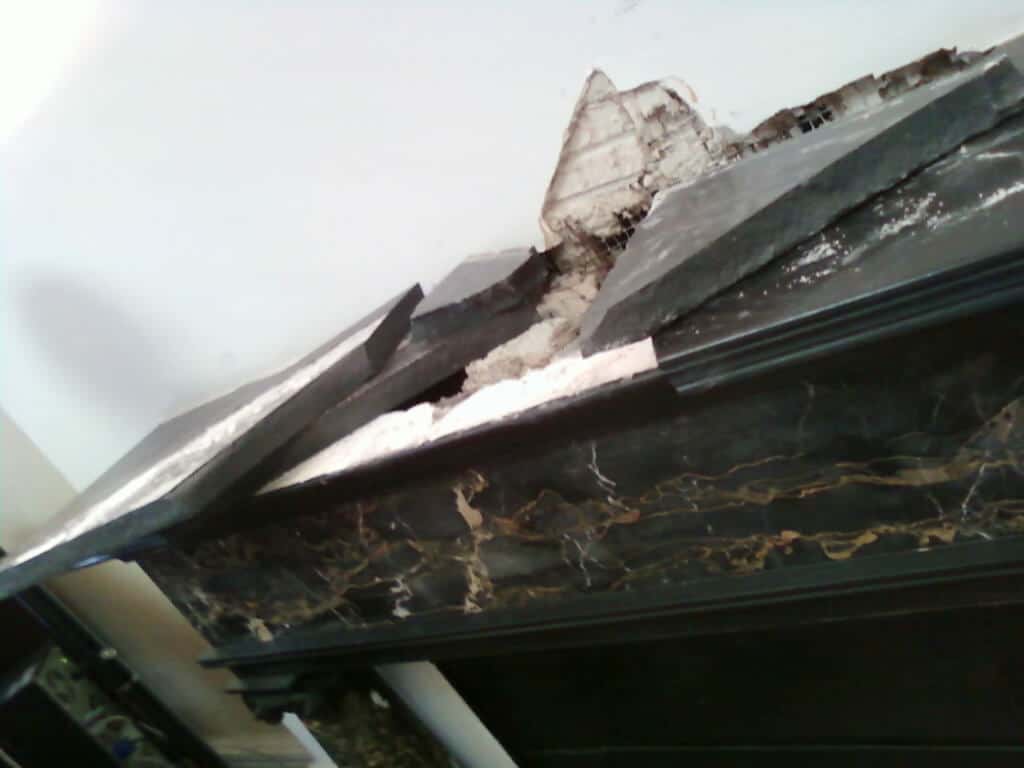
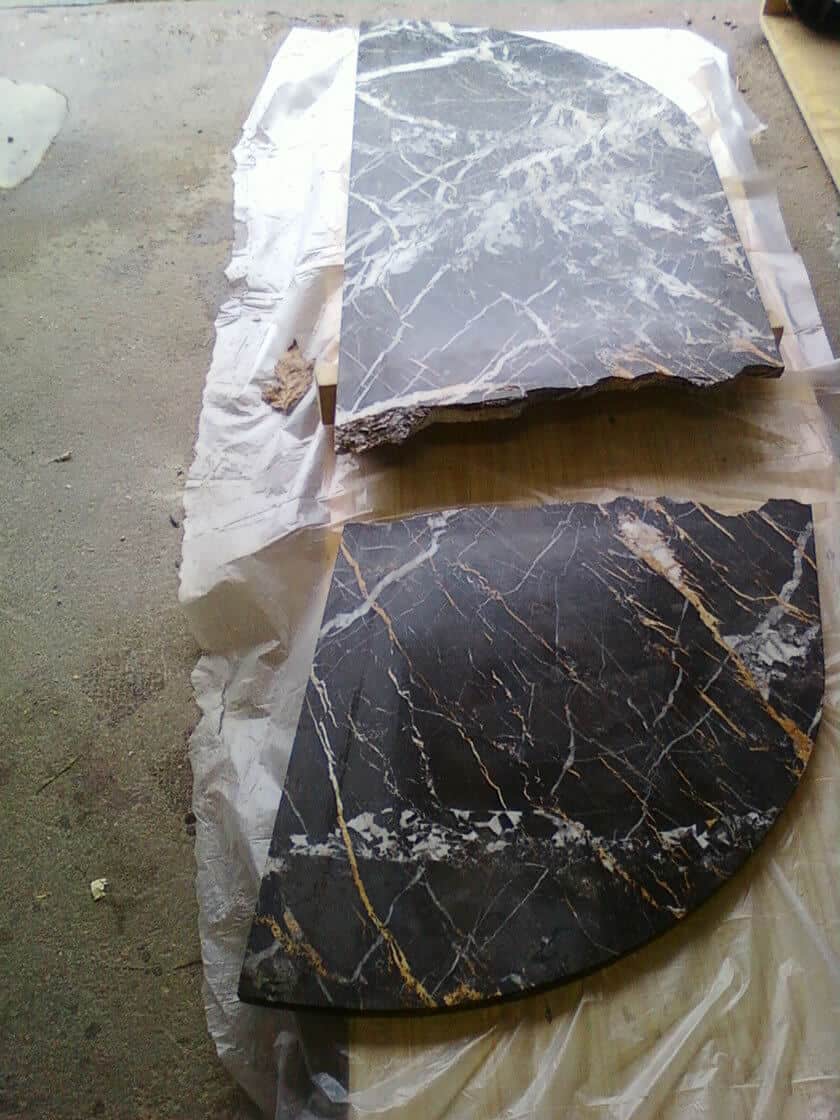
Cracks and chips are the damage types that tend to cause the most alarm — and understandably so. A crack running through a marble floor tile or a chip at the edge of a countertop looks serious. The good news is that most cracks and chips are repairable without replacing the stone, and the results, when done by someone who knows what they’re doing, are genuinely hard to spot.
Chips most commonly happen from impact — a heavy pot dropped on a kitchen counter, a piece of furniture dragged across a floor, a corner that’s been bumped one too many times. In NYC apartments, where kitchens are often compact and furniture moves happen frequently, marble countertop and floor chip repair is one of the most common jobs we see. The repair process involves cleaning the damaged area, filling it with a color-matched epoxy or polyester resin, allowing it to cure, and then grinding and polishing the repair flush with the surrounding surface. When it’s done right, the repair blends in rather than standing out.
Cracks are a bit more varied. Hairline cracks are often cosmetic — they don’t compromise the structural integrity of the stone, but they’re visible and they can collect dirt over time, making them more noticeable. These are typically filled with a thin resin and polished smooth. Wider cracks, particularly in floor tiles, can indicate underlying movement — building settlement, substrate shifting, or in Manhattan’s case, vibration from subway lines running beneath the street. In those situations, the crack repair is still achievable, but it’s worth understanding what caused it so the same issue doesn’t recur.
In pre-war buildings across the Upper West Side, Upper East Side, and Brooklyn Heights, we regularly work on marble that’s been settling for 80 or 100 years. The stone itself is often in better shape than people expect — it’s the accumulated damage from years of use and improper maintenance that makes it look worn out. Marble crack repair and marble chip repair, combined with proper surface restoration, can bring floors and countertops back to a condition that surprises even long-term residents who’d written them off as too far gone.
There’s a lot of vague language in this industry about “restoring” and “refinishing” marble, and it can be hard to know what you’re actually paying for. The process, when done correctly, follows a clear sequence — and each step matters.
It starts with an honest assessment of the damage. Not every surface needs the same approach, and our technicians will look at the type of stone, the depth and extent of the damage, and the finish that needs to be matched before any equipment comes out. Skipping this step is how expensive mistakes happen.
Marble scratch removal is one of those services that sounds simple but requires real precision. Scratches in marble range from fine surface scuffs — the kind left by grit tracked in on shoes — to deeper gouges from abrasive cleaning pads or tools. The depth of the scratch determines the starting point of the repair.
For surface-level scratches, the process typically begins with honing using progressively finer diamond abrasives. Think of it like sanding wood — you start with a coarser grit to remove the damaged layer and work your way to finer grits until the surface is smooth and consistent. From there, polishing brings the surface back to its intended finish. In a high-traffic NYC lobby, this might mean restoring a honed finish that’s been dulled by years of foot traffic and grit. In a residential kitchen, it might mean bringing a high-gloss Calacatta counter back to the mirror finish it had when it was installed.
Deeper scratches — the kind left by someone using the wrong equipment or a contractor who didn’t know what they were doing — require more aggressive intervention before the polishing stage can begin. We see this regularly in buildings where a previous contractor used harsh abrasives or the wrong chemicals and left the surface worse than they found it. Natural stone repair at this level isn’t just about aesthetics; it’s about correcting damage that, if left alone, will continue to worsen.
After the surface has been honed and polished to the correct finish, sealing is the final step. A penetrating sealer is applied to protect the restored surface from liquid penetration and staining — not etching, as mentioned earlier, but the kind of deep staining that happens when liquids soak into porous stone over time. This step is standard practice, not an upsell, and any reputable marble surface restoration job should include it.
The whole process — assessment, cleaning, repair, honing, polishing, sealing — is what separates professional marble restoration from a patch job. And in a city where the wrong contractor can leave you with floors that look worse than when you started, understanding what the process should look like is genuinely useful.
This is the question most people are quietly asking when they call about damaged marble. Is it worth repairing, or should we just replace it?
In most cases — the vast majority, actually — professional marble repair makes far more financial sense than replacement. Our marble restoration typically costs between $5 and $18 per square foot for floors and $1,200 to $3,500 for kitchen countertops, depending on the condition, size, and finish level. Full replacement in New York City, factoring in materials and premium labor rates, can run $50 to $200 or more per square foot. That’s not a small gap. For most homeowners and building managers, professional restoration represents savings of 70 to 90 percent compared to tearing out and reinstalling.
Beyond the cost, replacement in NYC comes with a layer of logistical complexity that restoration doesn’t. In a co-op or condo building, replacing marble often means board approval, contractor vetting, certificate of insurance submission, noise restriction scheduling, and coordination with building management — all before a single tile comes up. Our restoration work, by contrast, is typically far less invasive, generates less noise and dust, and can often be completed with minimal disruption to daily life or building operations.
There’s also the value argument. In a market where property values are as high as they are in Manhattan, Brooklyn, and the surrounding boroughs, original marble in good condition is a genuine asset. A Park Avenue lobby or a pre-war apartment with pristine original marble floors reads differently to buyers and co-op boards than one with newly installed substitute materials. Restoring what’s there preserves the character and the value of the space in a way that replacement often can’t replicate.
That said, replacement is sometimes the right answer — when damage is truly structural, when a tile has shattered beyond repair, or when the stone itself has deteriorated past the point where surface restoration can make a meaningful difference. An honest assessment will tell you which situation you’re in. What we’d caution against is assuming replacement is necessary before you’ve had a professional look at it. Most people are surprised by what can actually be saved.
If your marble looks dull, scratched, cracked, or chipped, the worst thing you can do is wait. Small damage compounds over time, especially in high-traffic areas. And the second worst thing you can do is attempt a DIY fix — the risk of creating uneven surfaces, irreversible scratches, or moisture damage is real, and we’ve seen plenty of jobs that started as a minor repair and became a major one after a well-intentioned DIY attempt.
New York City’s marble — in its pre-war lobbies, its SoHo lofts, its Midtown offices, and its residential kitchens — deserves to be handled by people who understand both the material and the environment it’s living in. Salt, vibration, dense foot traffic, and decades of use create damage patterns that are specific to this city, and fixing them well requires that kind of local experience.
We work across the five boroughs and the greater tri-state area, with experience on everything from single countertop repairs to full lobby restorations in landmark buildings. If you’re not sure what you’re dealing with or whether it can be fixed, reach out — we’re happy to take a look and give you a straight answer.
Article details:
Share:
Continue learning: