Serving NYC & Long Island
info@nycstonecare.com
24/7 Availability
The renovation is done; but your stone might already be in trouble. Here is what most homeowners in Manhattan and Long Island don't find out until it is too late.
Share:
Summary:
You just finished a renovation. The contractors are gone, the dust has (mostly) settled, and you are finally ready to enjoy the kitchen or bathroom you have been planning for months. But take a closer look at your marble countertop or limestone floor. Something is off; a haze you cannot wipe away, a dullness that wasn’t there before, maybe a faint scratch pattern across a surface that was supposed to be pristine. This isn’t just leftover dust. And it won’t clean up with a sponge and some dish soap. Here is what is happening to your stone, and why the next few days matter more than most people ever tell you.
Renovation work and natural stone are a difficult combination. The same process that installs your beautiful new surfaces also generates some of the most damaging substances those surfaces will ever encounter; and most of it happens in the same room, at the same time.
Construction dust is not ordinary household dust. It is a mixture of drywall compound, concrete particles, silica, adhesive residue, and grout powder; and when any of that settles onto a polished stone surface and gets rubbed around, even gently, it acts like sandpaper. The microscopic abrasion is invisible at first, but it adds up fast.
Then there is the chemistry problem. Many tile adhesives, grout cleaners, and standard construction surface treatments contain acids. Marble and limestone are composed primarily of calcium carbonate, which means they react to acid on contact; etching the surface in a way that no amount of regular cleaning will reverse.
If your renovation involved any tile work, a new backsplash, a tiled shower surround, a bathroom floor; grout haze is almost certainly on your stone surfaces right now. It is the thin, filmy residue left behind after grout is applied and wiped down. It looks like a cloudy film, and a lot of homeowners assume it will buff out with a little effort.
It won’t. Not once it sets. Grout contains alkaline compounds that bond to stone surfaces as they cure. The longer grout haze sits on marble or limestone, the more deeply it adheres; and at a certain point, no cleaner will touch it. What is required at that stage is professional honing: a controlled abrasive process that removes the affected surface layer and restores the stone beneath it. That is a significantly more involved job than it would have been if the haze had been addressed promptly.
This is one of the reasons timing matters so much. The first 48 hours after construction ends are genuinely critical. Construction residues; dust, grout haze, paint splatter, adhesive drips, joint compound; begin bonding to stone almost immediately. Every day that passes without professional attention makes the restoration more difficult and, in some cases, more extensive.
For homeowners across Manhattan, Nassau County, and Long Island, this situation plays out constantly. A pre-war co-op on the Upper West Side gets a kitchen renovation; the marble countertops come out of it looking hazy and dull. A Park Avenue condo gets a bathroom overhaul; the limestone floor has a faint but stubborn film that the contractor’s cleanup crew didn’t catch. The stone isn’t ruined; but it needs professional attention, and it needs it soon.
The same story repeats across Nassau County suburbs and Suffolk County. A newly renovated kitchen in Garden City, a master bath remodel in Huntington, a full gut renovation in Southampton; in every case, the stone surfaces that were meant to be the showpiece of the project come out of construction looking like they need work. Because they do.
This is the question almost every homeowner asks, and it is a fair one. The instinct to grab a cleaner and try to handle it yourself makes sense. But with stone, especially marble and limestone, the wrong move can make the damage significantly worse.
Wet cleaning on a stone surface that hasn’t been properly prepared first can drive construction particles deeper into the material and create water spots that etch into the surface. Most household cleaners; even ones marketed as “safe for stone”; are either too acidic or too alkaline for regular use on marble. Vinegar, lemon-based cleaners, and anything with bleach are all capable of etching marble on contact. What looks like a cleaning solution is a source of new damage.
The challenge is that you often cannot tell what you’re dealing with until you know what stone you have and what is on it. Granite behaves differently than marble. Travertine has a different porosity than limestone. Slate requires different handling than onyx. Each stone type responds differently to the same treatment; and what removes grout haze safely from granite can permanently dull a marble surface.
Professional post-construction stone cleaning involves a specific sequence: identifying the stone type, assessing the nature and depth of the contamination, using the right pH-neutral, stone-specific products, and applying professional equipment to clean, hone, polish, and reseal the surface in the correct order. It is not complicated to watch, but it requires the right knowledge and tools to do without causing additional damage.
We have been doing this work across Manhattan, Nassau County, Suffolk County, and Long Island since 2006. In that time, we have seen every variation of post-construction stone damage; and in the vast majority of cases, the stone is fully restorable. Most of what looks like permanent damage after a renovation is not. It just needs the right hands on it, sooner rather than later.
When we come in after a renovation, we are not just cleaning. We are assessing, treating, and restoring; and the process looks different depending on what the stone is, what happened to it, and how long it has been sitting.
The first step is always identifying the stone and understanding its current condition. A marble countertop that has grout haze and light surface etching needs a different approach than a granite floor with embedded construction dust and a compromised sealant. Getting that assessment right is what separates stone restoration from general cleaning; and it is where a lot of well-intentioned DIY attempts go wrong.
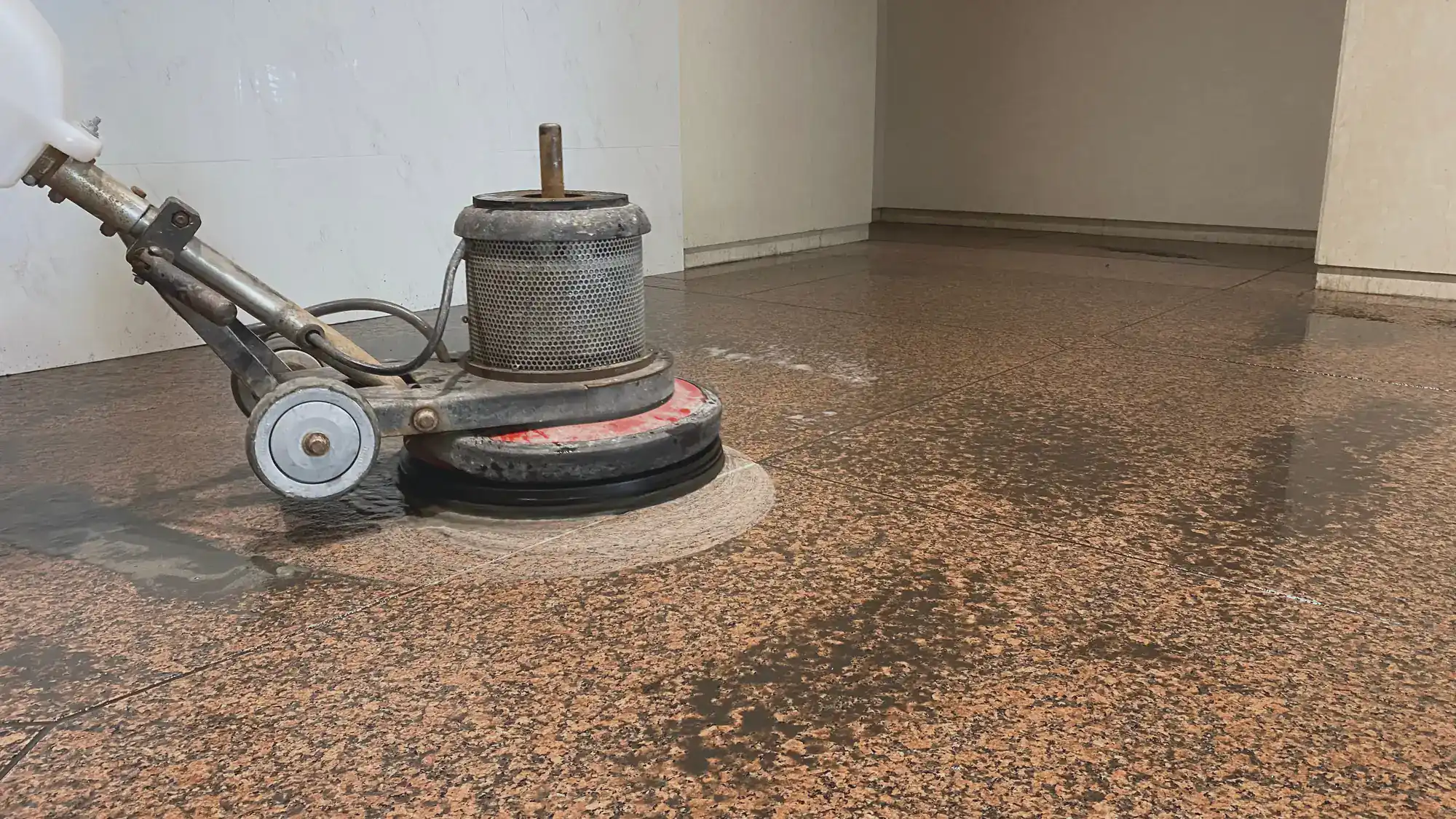
From there, the process typically involves professional honing or polishing using diamond abrasive tooling in progressive grits, followed by targeted treatment of any specific damage; stains, etch marks, cracks, or adhesive residue; and finishing with a professional-grade sealer application. The goal is to bring the stone back to the condition it was meant to be in before the renovation introduced all of those contaminants.
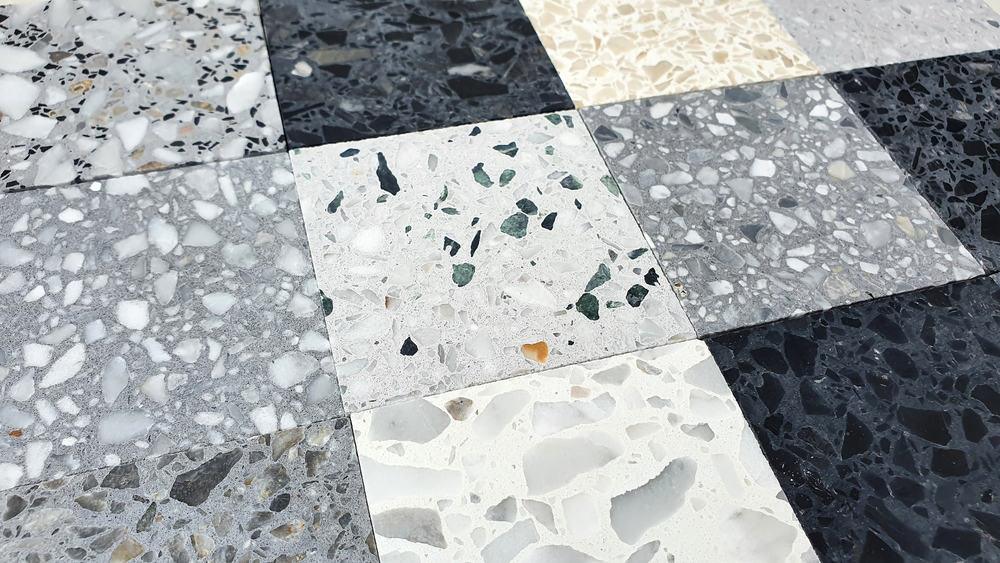
Marble is the stone we see most often in post-renovation situations, and it is also the most sensitive. Because marble is composed primarily of calcium carbonate, it reacts to acids, scratches more easily than granite, and shows etching and dullness more visibly than harder stones. A marble countertop or vanity top that goes through a renovation without protection is almost guaranteed to need professional attention on the other side.
Marble polishing after construction typically starts with a careful cleaning using pH-neutral, stone-specific solutions to remove loose surface contamination without driving it deeper. If there is grout haze or surface etching, honing comes next; a controlled abrasive process that removes the damaged surface layer and creates a uniform foundation for polishing. Then the polishing brings the stone back to its natural finish, depending on what the stone originally had.
If there are cracks, chips, or structural damage; from tools being set down on the surface, from vibration during demolition work, or from impact during material delivery; those are addressed with color-matched epoxy repair before polishing begins. The goal is always a seamless result, not a patch job.
For Manhattan homeowners dealing with pre-war marble that was already showing its age before the renovation, this process often produces results that exceed what the stone looked like going in. For newer installations in Nassau County and Suffolk County homes; the kind of marble countertops and limestone floors that are standard in mid-to-high-end renovations across Garden City, Manhasset, Huntington, and Smithtown; the goal is simply getting the stone to look the way it was supposed to look when it was installed.
One thing worth knowing: the restoration process is far less disruptive than most people expect. Our crew comes in, protects the surrounding area, does the work, and leaves the space clean. Multiple customers have specifically mentioned the care we take with their homes; showing up in protective booties, covering adjacent surfaces, and cleaning up thoroughly when the job is done.
This is the part of the conversation that tends to change how people think about the whole situation. When a homeowner sees their marble or granite looking rough after a renovation, the fear is that they are looking at another major expense; or worse, that they will have to tear it out and start over.
That is almost never the case. And the cost difference between professional stone restoration and full replacement is significant.
Post-construction stone damage; grout haze, surface etching, light scratches, embedded dust, minor cracks; is exactly the kind of damage that professional restoration is designed to address. It looks alarming, especially when you have just spent significant money on a renovation and the stone is supposed to be the centerpiece. But looking alarming and being permanently damaged are two very different things.
The calculus is straightforward: professional stone repair and restoration now costs far less than replacement later. And the longer post-construction residues sit on the stone, the more involved; and potentially more expensive; the restoration becomes. Grout haze that could have been addressed in the first week may require more aggressive honing after a month. Surface etching that catches early is simpler to reverse than etching that has been compounded by repeated incorrect cleaning attempts.
For homeowners across Long Island; if you are in a Nassau County suburb like Roslyn or Great Neck, or further east in Suffolk County towns like Babylon, Islip, or out toward the Hamptons; the renovation investment you have made is worth protecting. The stone surfaces you chose are durable, beautiful, and long-lasting when they are cared for correctly. Post-construction cleaning is part of that care. It is not an optional add-on to the renovation process; it is the step that makes everything you spent hold up.
We also hear from a lot of homeowners who tried to wait it out, assuming the stone would look better once they settled in. It doesn’t work that way. Stone doesn’t improve on its own. What is there after construction is what is there; until a professional addresses it.
The short answer: as soon as the contractors leave. The longer answer: definitely before you attempt to clean anything yourself, and certainly before you assume the damage is permanent and start pricing out replacements.
If your marble looks hazy, your granite is dull, your limestone floor has a film that won’t wipe off, or your countertops came out of a renovation looking like they went through a war; that is a restoration conversation, not a replacement one. The damage is almost certainly fixable. The question is how quickly you move on it.
We have been working with homeowners and commercial property owners across Manhattan, Nassau County, Suffolk County, and Long Island since 2006, and we have seen this situation hundreds of times. If you are not sure what you are dealing with, reach out to NYC Stone Care. We will take a look, tell you honestly what is going on, and give you a clear picture of what it takes to make it right.
Article details:
Share:
Continue learning: