Serving NYC & Long Island
info@nycstonecare.com
24/7 Availability
Two beautiful stones. Two very different maintenance realities, especially in New York. Here's what you need to know before choosing or restoring either one.
Share:
Summary:
If you’re choosing between marble and travertine, or you already have one and you’re trying to figure out why it doesn’t look the way it used to, you’ve probably noticed that most of the information out there is vague, promotional, or written for someone in a completely different climate. New York isn’t Phoenix. It isn’t Miami. The salt, the hard water, the freeze-thaw cycles on Long Island, the cleaning crews in Manhattan co-ops; all of it changes the equation. So let’s talk about what these two stones do in a Manhattan or Long Island home, and what it takes to keep them looking the way they should.
Most people treat marble and travertine as interchangeable; both are natural stone, both are calcium-based, both look elegant in a kitchen or bathroom. But they form differently, they fail differently, and they need different types of care when something goes wrong.
Marble is a metamorphic rock. It starts as limestone and gets transformed under intense heat and pressure over millions of years, which gives it that dense, crystalline structure and the veining patterns people love. Travertine is sedimentary; it forms from mineral deposits left behind by hot springs and groundwater, which is why it has those natural voids and pits running through it.
That geological difference isn’t just trivia. It’s the reason these two stones respond to damage, cleaning products, and environmental stress in completely different ways.
Marble’s biggest vulnerability is acid. And not industrial acid; everyday acid. Wine, lemon juice, vinegar, tomato sauce, and a long list of common household cleaners all qualify. When any of these make contact with marble, they trigger a chemical reaction with the calcium carbonate in the stone. The surface doesn’t just stain, it etches. The crystal structure of the stone itself gets eaten away, leaving behind a dull, slightly rough patch that no amount of cleaning will fix.
This is the part that catches most marble owners off guard. They see a dull spot, they scrub harder, they try a different cleaner, and nothing works. That’s because the damage isn’t on the surface; it’s in the stone. The only way to remove an etch mark is through mechanical restoration: grinding away the damaged layer and polishing the stone back to its original finish using progressively finer diamond abrasives. It’s a process that requires professional equipment and real expertise, particularly when the marble has a honed or specialty finish that needs to be matched exactly.
In Manhattan apartments, this problem gets compounded by something most homeowners don’t think about: the cleaning crew. Building cleaning services and hired housekeepers often use products that aren’t formulated for natural stone. Some products marketed as all-purpose or even “stone-safe” are acidic or alkaline enough to etch marble on contact. We hear this constantly from clients in Upper East Side and Upper West Side co-ops; the marble looked fine for years, then suddenly it doesn’t, and the only thing that changed was the cleaning product.
One wrong spray, left on the surface for a few minutes, can undo the finish on a countertop or vanity that’s otherwise in perfect condition.
The other factor in Manhattan specifically is winter. Salt gets tracked in from sidewalks and streets from November through March. Salt is abrasive, and it’s chemically reactive with marble.
Over a season of foot traffic, it can dull a marble floor in ways that look like normal wear but are accelerated chemical damage. Spring is consistently one of our busiest times for marble polishing and marble restoration in Manhattan for exactly this reason.
Travertine is less sensitive to acid than marble; it’s still calcium-based, so it can etch, but it’s more forgiving in everyday kitchen and bathroom use. The bigger issue with travertine is its porosity. Those natural voids and pits that give travertine its character are also pathways for moisture, debris, and cleaning products to work their way into the stone. Left unsealed or under-sealed, travertine absorbs everything.
In indoor applications, bathroom floors, shower surrounds, kitchen countertops, unfilled or poorly sealed travertine traps soap scum, hard water minerals, and bacteria in its voids. It can look clean on the surface while holding grime in every pit. In high-use areas, the surface itself wears down faster than marble because travertine rates slightly lower on the Mohs hardness scale (3–4, compared to marble’s 3–5). It’s a subtle difference, but it adds up over years of foot traffic.
On Long Island, travertine faces an additional challenge that most homeowners don’t fully account for when they’re choosing stone for outdoor spaces. Pool surrounds, patios, and entry steps in Nassau County and Suffolk County go through multiple freeze-thaw cycles every winter.
Water that gets into unsealed travertine, through its natural voids or through surface cracks, expands when it freezes. That expansion puts pressure on the stone from the inside, causing cracking, spalling, and in some cases full delamination. We see this every spring in communities from Garden City to Huntington to Southampton. A travertine patio that looked fine in October can look significantly worse by April if it wasn’t properly sealed before winter.
The sealing frequency difference between the two stones is real and worth understanding before you commit. Marble typically needs sealing every one to three years depending on the finish and how heavily the surface is used. Travertine, especially in high-traffic indoor areas or any outdoor application, generally needs sealing every six to twelve months. That’s not a dealbreaker, but it’s a maintenance commitment that catches a lot of Long Island homeowners off guard when they chose travertine for a pool surround thinking it was low-maintenance stone.
Both stones are repairable, but the repair process looks different, and the window for catching problems before they get worse is different too. With marble, the most common issues we address are etching, scratches, chips, and cracks. With travertine, it’s typically void deterioration, surface wear, staining from within the stone, and freeze-thaw damage on outdoor installations.
The good news for homeowners throughout Manhattan and Long Island is that most damage that looks permanent isn’t. Etch marks that make marble look ruined can be polished out.
Travertine voids can be filled and the surface refinished. Cracks in both stones can be repaired in ways that are nearly invisible when done correctly. The question is always if the right approach is being applied to the right problem, and that starts with assessing the stone before any work begins.
Yes, and this is probably the most important thing to understand about marble repair, because the misconception that etch marks are permanent leads a lot of homeowners to replace stone that could have been restored for a fraction of the cost.
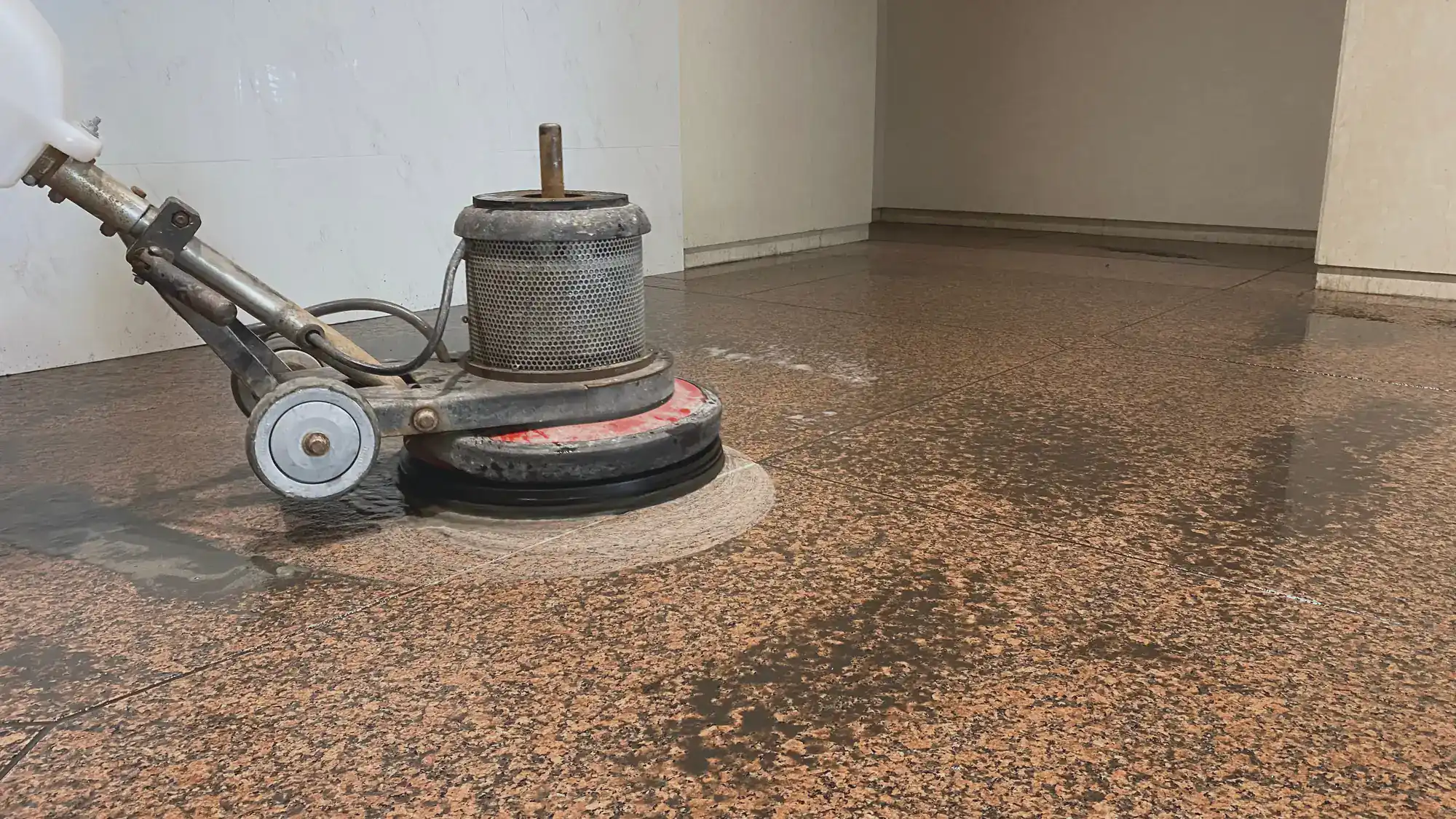
Etching, dullness, and surface scratches in marble are addressed through a process of grinding and polishing. A technician works through progressively finer diamond abrasives, removing the damaged layer of stone and bringing the surface back to its original finish. For polished marble, this means restoring the mirror-like clarity. For honed marble, which is increasingly common in Manhattan kitchens and bathrooms, it means bringing back the flat, matte finish without accidentally introducing shine. Matching the original finish matters enormously, and it’s one of the things that separates experienced stone restoration professionals from general contractors who happen to own a polisher.
Chips and cracks are handled differently. Small chips on countertops, vanities, or fireplace surrounds are typically filled with color-matched epoxy or polyester filler, then ground flush with the surrounding surface and polished to match. Larger cracks, particularly in marble floors, may require more involved stone repair work, but the principle is the same: stabilize the damage, fill it, and restore the surface to match what’s around it.
We work on marble throughout Manhattan; pre-war co-op bathrooms on the Upper West Side, kitchen countertops in Tribeca lofts, lobby floors in SoHo buildings; and the range of what’s fixable consistently surprises people. The most common thing we hear after a job is done is some version of: “I had no idea it could look like this again.”
Travertine restoration typically involves a few different components depending on what’s wrong. If the surface has worn down from foot traffic, it needs to be honed or polished back to an even finish. If voids have opened up or the original fill material has deteriorated, those need to be re-filled with a product that matches the stone’s color and texture before the surface can be properly refinished. If there’s staining from hard water minerals, which is extremely common in parts of Nassau County and Suffolk County where municipal water runs high in calcium and magnesium, that needs to be addressed with stone-safe products before any polishing begins.
Hard water staining on travertine looks different from etching on marble, but it’s just as frustrating to deal with on your own. The mineral deposits bond with the stone’s surface over time and resist normal cleaning. You can scrub and scrub and the haze doesn’t lift, because what you’re seeing isn’t dirt; it’s mineral buildup that’s fused to the stone. Professional stone cleaning using the right techniques and products removes it without damaging the travertine underneath.
For outdoor travertine on Long Island; pool surrounds in Great Neck or Cold Spring Harbor, patios in Oyster Bay or Huntington, entry steps in Hamptons estates in Southampton or East Hampton; the restoration process often starts with an honest assessment of freeze-thaw damage. If the stone has cracked or spalled over the winter, those areas need to be repaired or replaced before sealing. Sealing over damaged stone doesn’t fix the underlying problem; it just traps moisture inside. The correct sequence is always to restore first, then seal.
Granite repair follows a different path entirely; granite rates 6–7 on the Mohs scale, making it significantly harder and more resistant to both etching and surface scratching than either marble or travertine. When granite does need attention, it’s usually for chip repair, crack stabilization, or resealing, and the process is generally less involved than what marble restoration requires. It’s worth knowing the distinction if you have multiple stone types in your home, which is common in Nassau County and Suffolk County properties where kitchens and bathrooms may feature granite countertops alongside marble or travertine flooring.
If you’re choosing between marble and travertine, the honest answer is that both are excellent stones, but neither is low-maintenance in a New York home, and the one that’s “easier” depends entirely on where it’s going and how it’ll be used. Marble is more vulnerable to acid and etching, which matters a lot in kitchens and anywhere cleaning products are used. Travertine needs more frequent sealing and is more vulnerable to freeze-thaw damage, which matters a lot for outdoor applications on Long Island.
If you already have one or both and something has gone wrong, the most important thing to know is that the damage is probably fixable. Etch marks, dullness, chips, cracks, worn travertine, hard water haze; these are all things that professional stone restoration can address without tearing anything out.
NYC Stone Care has been working on marble, travertine, granite, and natural stone throughout Manhattan, Nassau County, Suffolk County, and Long Island since 2006. If you’re not sure what you’re looking at or what it would take to fix it, reach out; we’re straightforward about what’s possible and what it involves.
Article details:
Share:
Continue learning: