Serving NYC & Long Island
info@nycstonecare.com
24/7 Availability
Marble damage often starts invisibly. Here's what's actually happening beneath the surface — and what it takes to bring your floors back.
Share:
Summary:
You clean your marble floors regularly. Maybe even obsessively. And yet something still looks off — a flatness to the surface, a haze that won’t lift, a dull patch where there used to be a shine. It’s frustrating, especially when you’ve done everything right. The problem is that most marble damage doesn’t come from neglect. It comes from the wrong products, the wrong environment, and a slow accumulation of damage that’s completely invisible until it isn’t. This page explains what’s actually happening to your marble, what the restoration process looks like, and what to expect when you bring in a professional.
Marble is a calcium carbonate-based stone, which sounds technical but has one very practical implication: it reacts chemically with acid. Not just harsh industrial cleaners — everyday things like lemon juice, wine, coffee, and even certain “all-purpose” cleaning sprays will etch the surface on contact. That etching isn’t dirt. It’s actual surface damage, and no amount of mopping will fix it.
What makes this particularly frustrating is that the damage builds gradually. Each small exposure leaves a microscopic mark. Over months and years, those marks accumulate into the dull, hazy surface you’re looking at now. By the time it’s visible, it’s usually well past what a consumer polish kit can address.
If you live in Manhattan or anywhere across Nassau County and Long Island, your marble has a specific enemy that most people never think about: winter road salt. Every time someone walks through your front door between November and March, they’re tracking in a fine residue of salt and de-icing chemicals from the sidewalk. That residue settles into the surface of your marble floors, and because it’s acidic, it etches quietly with every pass.
In apartment buildings across the Upper West Side, the Upper East Side, and Midtown Manhattan, lobby marble takes the worst of it. Building maintenance staff clean the floors daily — but often with commercial products that aren’t pH-neutral, which compounds the damage rather than stopping it. By spring, what looked like a minor dullness in October has turned into a surface that no longer reflects light the way it should.
Long Island homes in Nassau County communities like Manhasset, Roslyn, and Old Westbury face a similar pattern, particularly in South Shore areas and anywhere close to the water. Coastal humidity and salt air add a layer of environmental stress that accelerates surface degradation on marble and other natural stone. Homes in the Hamptons, along the Great South Bay, or on the North Shore waterfront see this more acutely than properties further inland. The stone isn’t failing — it’s reacting to its environment, the way marble always has.
Hard water is another factor that rarely gets enough attention. New York City tap water carries a relatively high mineral content. In bathrooms and kitchens, that water leaves calcium deposits on marble surfaces over time — the white haze around faucets and drains that looks like a stain but is actually mineral buildup bonded to the stone. Standard cleaning products don’t dissolve it. They often make it worse.
The point is that marble damage in this region isn’t random. It follows predictable patterns based on where you live, how your building is maintained, and what’s in the air and water around you. Understanding that makes it easier to address — and easier to prevent going forward.
Etching shows up differently depending on the marble type and the severity of exposure. On polished marble, it typically looks like a dull spot or a cloudy ring — the kind of mark that appears after a glass of wine sits on the counter too long, or after a cleaning product is left on the floor. On honed marble, it can be harder to spot, but you’ll notice it as an uneven texture or a surface that no longer feels consistent underfoot.
The reason people mistake etching for dirt is simple: it looks like something that should clean off. You wipe it, it stays. You mop it, it stays. You try a stronger cleaner — and if that cleaner is acidic, you’ve just added more etching to the problem. This is one of the most common ways minor surface damage turns into something that requires professional marble restoration.
Chips and cracks are more obvious, but they carry their own misconceptions. A lot of people assume a chipped marble countertop or a cracked floor tile means replacement. That’s rarely true. Professional stone repair uses color-matched fillers and precision techniques to restore the surface so cleanly that the repair is invisible — not patched-looking, actually invisible. We’ve had customers tell us they genuinely cannot find where the chip was after the work is done. That outcome isn’t unusual; it’s the standard we hold ourselves to.
Pre-war buildings in Manhattan add another layer of complexity. Marble installed in the 1920s and 1930s behaves differently than modern stone. The quarrying methods, the finish types, and the way the stone has aged over 80 to 100 years all factor into how it should be treated. A restoration approach that works perfectly on a new Calacatta marble kitchen island in Garden City may not be appropriate for original Carrara marble in a classic Park Avenue bathroom. That’s why individual assessment matters — not as a sales step, but as a practical necessity.
Marble restoration isn’t a single service — it’s a sequence of steps, and which steps apply depends entirely on the condition of your stone. A surface with light etching needs something different than one with deep scratches, mineral buildup, and a crack running across the center. Skipping steps, or applying the wrong process to the wrong problem, produces results that don’t last.
The core sequence typically moves from grinding or honing — which removes the damaged layer of the surface — through polishing, which rebuilds the finish, and ends with sealing to protect everything that was just done. Each stage requires the right equipment, the right abrasive sequence, and a clear understanding of the stone you’re working with.
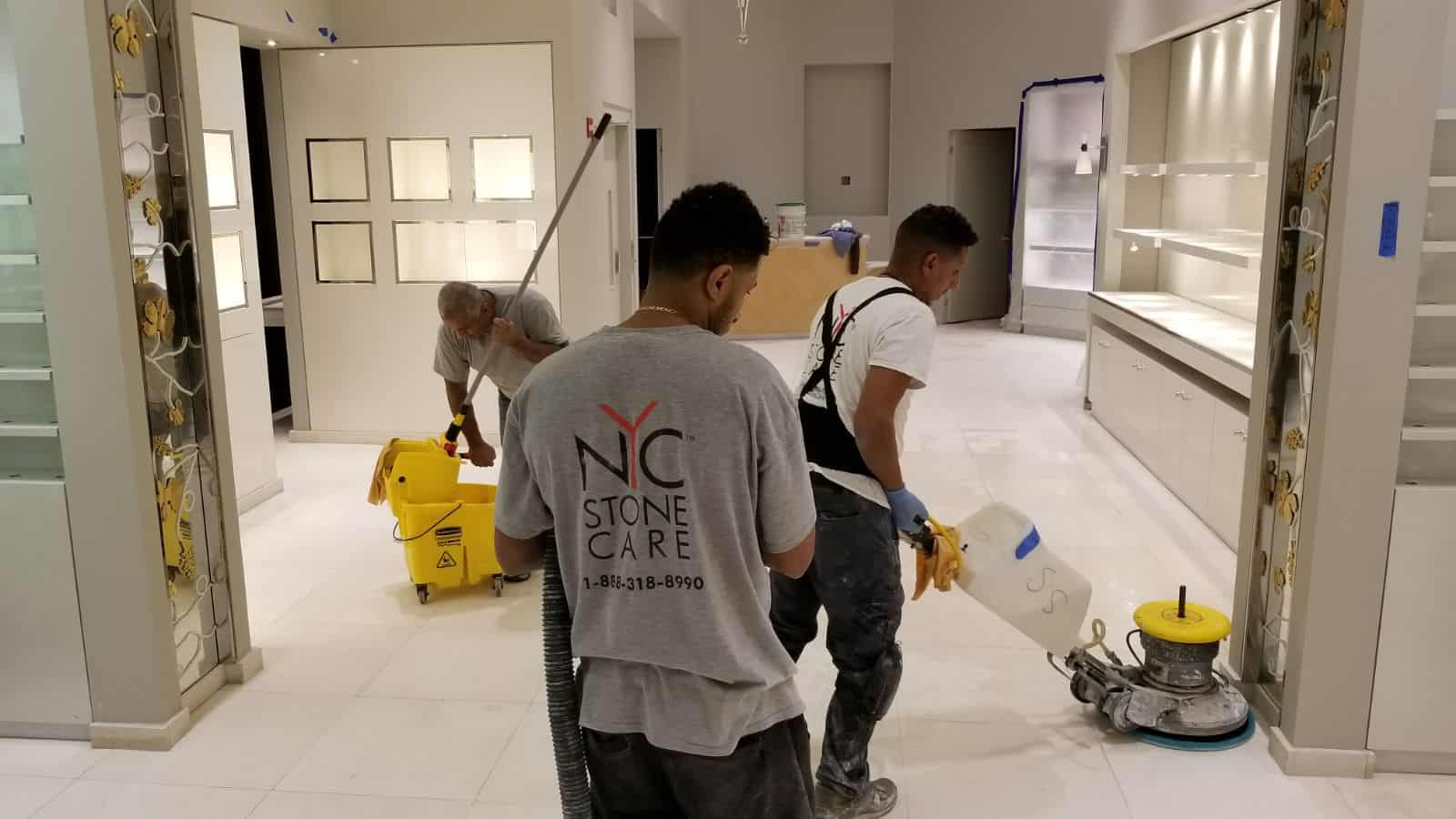
Polishing is one part of the restoration process, not the whole thing. When a surface has light surface dulling and minimal etching, polishing alone may be enough to bring the shine back. But polishing a surface that has deep etching, scratches, or uneven texture underneath is like painting over a wall without fixing the plaster — it looks better briefly, then the underlying problem shows through.
Full marble restoration starts with honing: a grinding process that uses diamond abrasives to level the surface and remove the damaged layer entirely. This is what actually addresses etching, scratches, and surface inconsistencies. Once the surface is even and smooth, polishing builds the finish back up — whether that’s a high mirror gloss or a matte honed look, depending on what the stone had originally and what you prefer.
Sealing comes last, and it matters more than most people realize. An unsealed marble surface after restoration is immediately vulnerable again. A professional-grade sealant applied correctly after polishing extends the life of the restoration significantly — most marble surfaces benefit from resealing every six to eighteen months, depending on how much traffic they see and what they’re exposed to. In a busy Manhattan kitchen or a Long Island home with kids and pets, the lower end of that range is more realistic.
The equipment we use also separates professional restoration from DIY attempts. Wet diamond grinding systems prevent the heat and dust that dry grinding creates — both of which can damage the stone and the surrounding space. In a NYC apartment or co-op, where neighbors are close and building rules govern noise and dust, this matters practically, not just technically. Our technicians arrive prepared for that environment: protective coverings go down, booties go on, and the worksite stays clean throughout.
This is the question most people are quietly asking before they ever call anyone. And the honest answer, in almost every residential case, is yes — by a significant margin.
Full bathroom renovation quotes in Manhattan regularly start at $12,000 and climb from there. A professional marble restoration of the same bathroom — floors, walls, vanity — costs a fraction of that and produces a result that’s genuinely hard to distinguish from new. We’ve had customers come to us after getting renovation quotes in that range, and leave with restored marble that looks better than it did when the apartment was built.
For Long Island homeowners in Nassau County, the calculation is similar but the scale is often larger. Homes in communities like Manhasset, Roslyn, and Old Westbury typically have more extensive marble and stone installations than a Manhattan apartment — larger kitchen surfaces, multiple bathrooms, entryways, and sometimes exterior stone as well. Replacing all of that is a major project. Restoring it, done properly, is a smart investment that adds to the property’s value rather than just maintaining it.
There’s also a timing consideration that’s worth thinking about. If you’re planning to sell, restored marble reads as premium to buyers — it photographs well, it feels well-maintained, and it signals that the property has been cared for. If you’re staying, restored and sealed marble is significantly easier to maintain going forward than a damaged surface that traps dirt and shows every mark.
The one case where replacement makes more sense is structural damage — a floor that’s cracked through due to subfloor movement, or stone that’s been so severely damaged that the surface integrity is compromised. That’s genuinely rare in residential settings. Most of what people assume requires replacement can be restored cleanly, invisibly, and at a cost that makes the decision straightforward.
The stone care market in New York is crowded, and the gap between operators is wide. Years in business, a verifiable local presence, and a track record of real reviews matter more here than anywhere else — because marble is expensive, and a bad restoration can cause damage that’s harder to fix than the original problem.
We’ve been working in Manhattan, Nassau County, Suffolk County, and across Long Island for nearly 15 years. Our office is registered in Merrick, NY — we’re not a Manhattan company that occasionally crosses the bridge. We know what pre-war Carrara marble in a Park Avenue co-op needs, and we know what salt air does to travertine on the South Shore.
If your marble floors are looking dull, hazy, or just not the way they used to, it’s worth getting an honest assessment before assuming the worst. We’re happy to take a look, give you a straight answer, and tell you exactly what the work involves before anything starts.
Article details:
Share:
Continue learning: