Serving NYC & Long Island
info@nycstonecare.com
24/7 Availability
Stone floors in NYC take a beating. Here is how the smartest commercial properties keep them looking sharp, without replacing them.
Share:
Summary:
If you manage a commercial property in Manhattan, Nassau County, or Suffolk County, you already know that stone floors do not fail all at once. They fade gradually, a little duller each season, a little more worn near the entrance, until one day a tenant says something or you catch it in the wrong light and realize the lobby no longer looks the way it did. By that point, the conversation has shifted from maintenance to damage control. This post is about avoiding that conversation entirely, and understanding what the properties with the best-looking stone floors in Manhattan and Long Island are doing differently.
Stone is durable, but it is not indestructible, and the environment in New York City is uniquely hard on it. Manhattan lobbies absorb thousands of foot contacts every day. Long Island properties near the water deal with salt air and humidity that accelerate surface degradation in ways that are not obvious until the damage is already done. The real problem is that most of what is destroying a stone floor is not visible in real time. It accumulates. And because the floor still looks passably clean after a mop, the underlying wear gets ignored until it cannot be anymore.
From November through March, the single biggest threat to commercial stone floors in Manhattan and across Long Island is not foot traffic; it is what is on people’s shoes when they walk in. Road salt and deicing chemicals are tracked into Manhattan lobbies and Long Island commercial spaces every day during winter, and they are highly corrosive to marble and limestone.
These are not surfaces that shrug off chemical exposure. Marble and limestone are both calcium-based stones, which means acidic substances, including the residue left by deicing agents, cause a chemical reaction that etches the surface. That is not a stain you can mop away. It is a change to the stone itself.
What makes this worse in a high-traffic commercial setting is volume. A residential entryway might see fifty people a day. A Manhattan office lobby might see that many in the first twenty minutes. Every one of those contacts is an opportunity for grit, salt, and debris to abrade the surface.
Fine scratches accumulate into a floor that looks flat and tired, not dirty, just worn. And none of that responds to cleaning. This is the part most property managers do not realize until they have already tried cleaning the floor twice and it still does not look right.
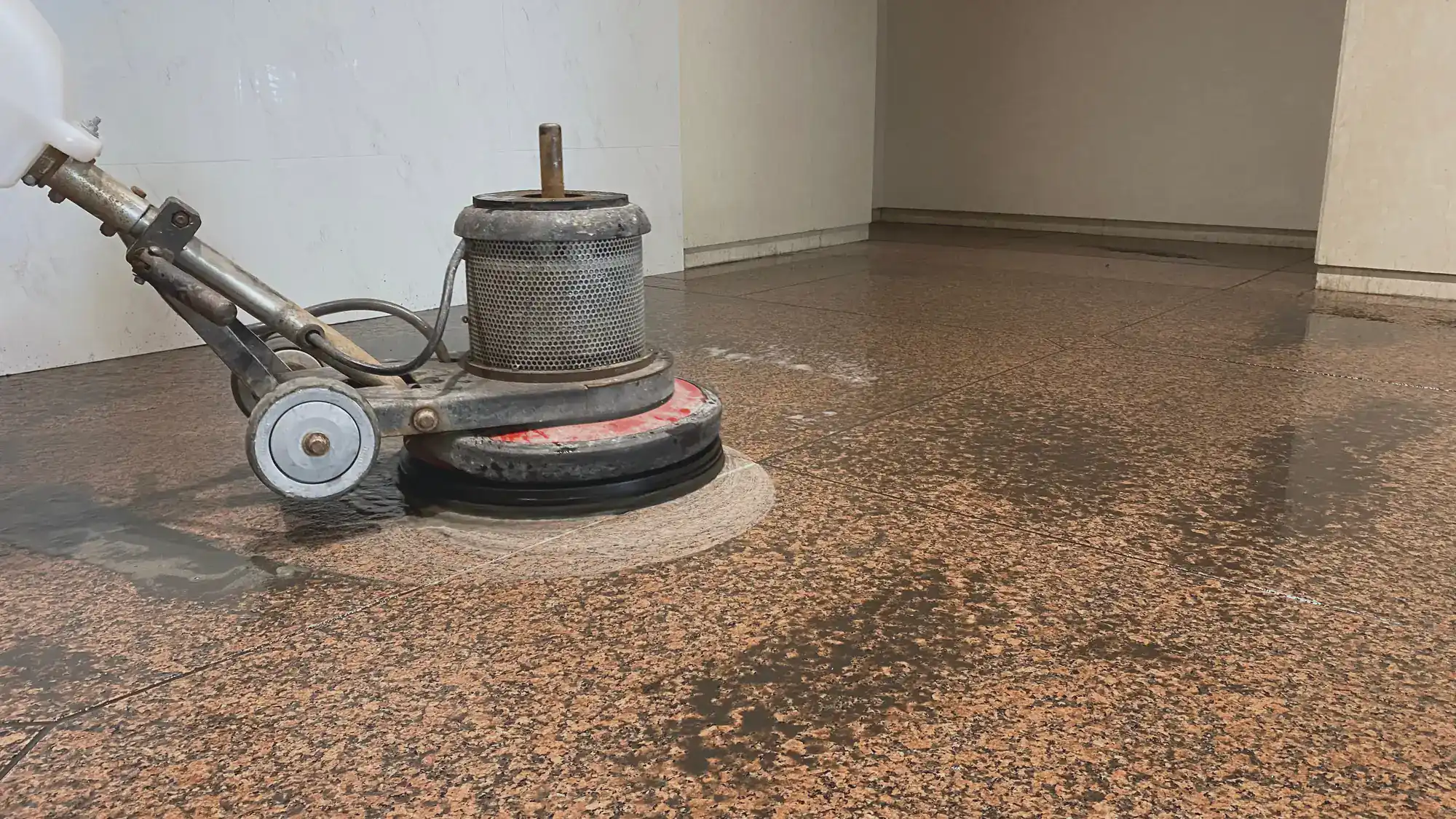
Scratches and etch marks are mechanical and chemical damage. Addressing them requires mechanical and chemical solutions, specifically, honing with diamond abrasive pads to remove the damaged surface layer, followed by polishing to restore the finish. That is stone restoration, and it is a different process entirely from maintenance cleaning.
The properties in Manhattan and across Long Island that manage this well are not doing anything exotic. We schedule professional stone care before winter sets in and again in spring, when the damage from the season can be assessed and corrected before it compounds further.
The stone care challenges in Nassau County and Suffolk County are not identical to Manhattan’s, and treating them the same way is a mistake. Properties along the Nassau and Suffolk coastlines, from Great Neck and Manhasset in the west to Westhampton Beach and the North Fork in the east, deal with elevated ambient humidity and salt air that penetrate stone surfaces in ways that interior urban environments do not produce.
Natural stone is porous. Even well-sealed stone eventually allows some moisture exchange with its environment, and in a coastal setting, that moisture carries dissolved salts. Over time, this contributes to efflorescence, the white, powdery mineral deposits that appear on stone surfaces, and to a gradual breakdown of the surface finish that makes stone look dull and aged even when it is structurally sound.
For luxury residential properties in the Hamptons or high-end commercial spaces in Garden City, this is not a minor cosmetic issue. These are properties where appearance directly reflects value. A marble bathroom in a Westhampton Beach home, a granite reception desk in a Mineola professional office, a limestone entry in a North Fork estate; each of these surfaces is an investment, and each is vulnerable to the specific conditions of this market in ways that generic stone care advice does not account for.
What works in these environments is a combination of appropriate sealing, penetrating sealers that protect from within rather than topical coatings that sit on the surface and eventually peel, and a maintenance schedule calibrated to the exposure level of the specific property. A beachfront property in Suffolk County needs more frequent attention than an inland Nassau County office. That is not a sales pitch; it is just how the material behaves in these conditions.
Over nearly 15 years of working in this market, we have found that the difference between a Long Island stone floor that holds up beautifully and one that needs emergency restoration every two years almost always comes down to the sealing and maintenance program being matched to the environment of the property.
At some point in every commercial property manager’s career, someone suggests that the stone floor has reached the end of its useful life and needs to be replaced. Sometimes that is true. More often, it is not, and the cost difference between those two decisions is significant enough to be worth understanding clearly before any decision is made.
Full marble replacement typically runs $50 to $150 per square foot. Apply that to a 500-square-foot lobby and you are looking at $25,000 to $75,000, plus one to three weeks of unusable space during installation. Professional stone restoration, by comparison, is 70 to 90 percent less expensive in most cases, and most restoration projects are complete in one to three days.
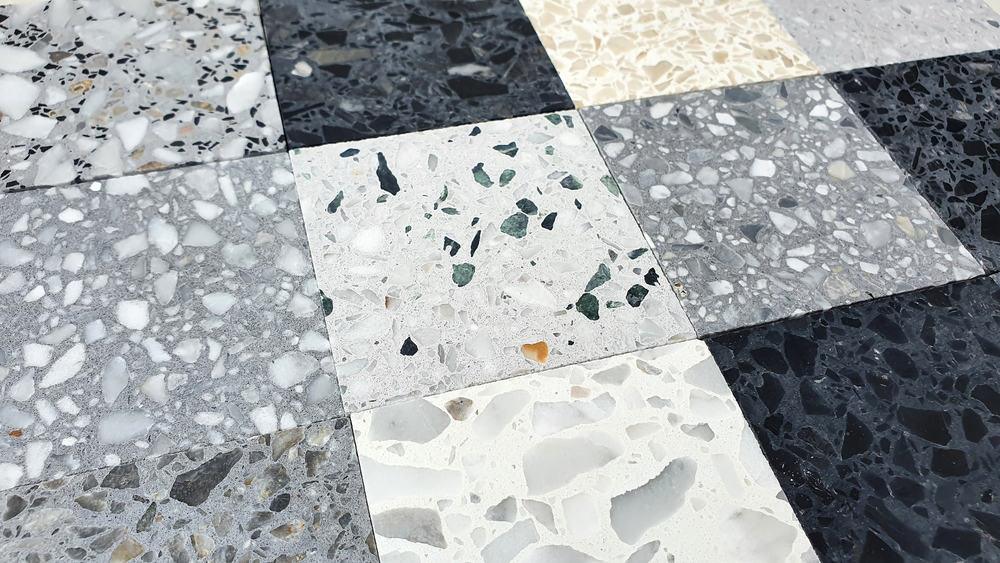
The most common mistake property managers make is assuming that a floor in poor condition needs to be replaced. The honest answer is that most stone, even stone that looks severely damaged, can be restored to a condition that genuinely surprises people.
We have had customers tell us they were quoted $12,000 or more for a full bathroom renovation, and after marble restoration, they could not believe the difference. One customer said it plainly: “The marble was old and abused. NYC Stone Care came in and left our bathroom in a stunningly amazing state.”
The question is not really “how bad does it look” but “what kind of damage is present?” Surface scratches, etch marks, dullness, minor chips, and cracks are all restorable in the hands of someone who knows what they are doing. A chip that looks catastrophic is often a color-match and fill repair that leaves the surface looking untouched.
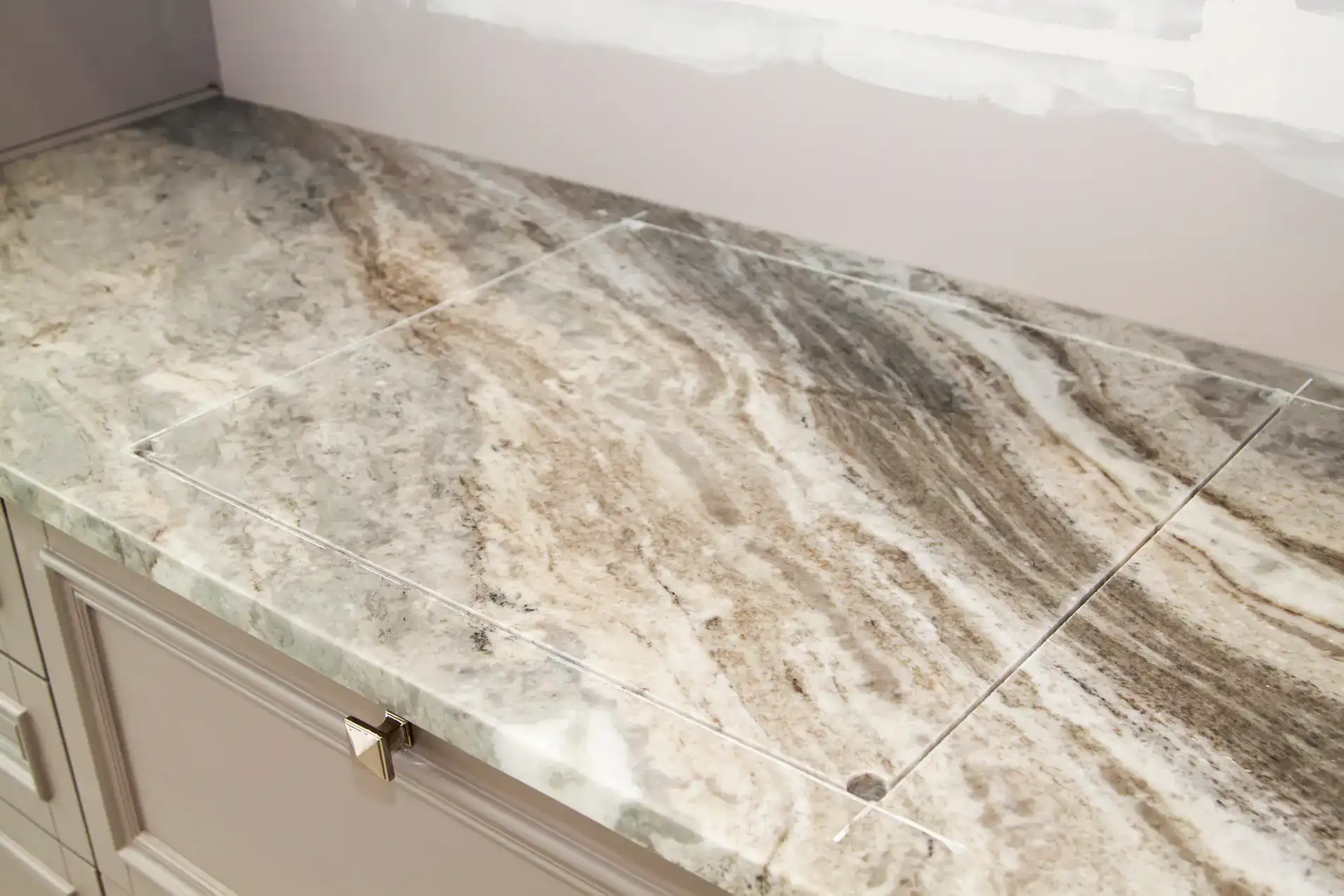
We have had customers tell us a large piece of their granite countertop came off, and after repair, you could not tell it was ever broken. What requires replacement is structural failure, stone that has cracked through completely, delaminated from its substrate, or been damaged by water intrusion to the point where the underlying surface is compromised.
A professional assessment will tell you quickly which category you are dealing with. The key is getting that assessment before committing to a replacement budget, not after. For commercial property managers who need to bring a recommendation to building ownership or a board, the math is straightforward: stone restoration at a fraction of the replacement cost, completed in days rather than weeks, with results that restore the floor to a condition that reflects well on the property.
The commercial properties in Manhattan and Long Island with the best-looking stone floors are not the ones with the most expensive original stone. They are the ones that treat maintenance as a scheduled system rather than a response to visible problems.
Here is what that looks like in practice. For a medium-traffic commercial lobby, say, a professional office building in Mineola or a boutique hotel in Manhattan, professional stone maintenance every 12 to 24 months is typically sufficient to keep the surface in good condition, supplemented by appropriate daily cleaning with stone-safe products. High-traffic settings, retail corridors, transit-adjacent lobbies, restaurant floors, may need attention more frequently, sometimes every one to two years for polishing or light restorative work, with quarterly cleaning built into the routine.
The reason this matters financially is compounding. A floor that receives regular professional attention stays in the polishing-and-sealing range of care, relatively straightforward and cost-effective. A floor that goes years without professional attention accumulates damage that eventually requires full honing and restoration, which is more labor-intensive and more expensive.
A floor that goes long enough without any professional care may reach the point where restoration itself becomes a larger project than it needed to be. Sealing is the other piece that gets underestimated. A properly applied penetrating sealer does not make stone impervious, but it dramatically slows the rate at which stains, moisture, and contaminants penetrate the surface.
In a coastal Long Island environment or a Manhattan lobby that sees winter salt tracked in for five months a year, that protection is doing real work. The sealer needs to be reapplied periodically; the frequency depends on traffic and stone type, but it is one of the most cost-effective things a commercial property can do to extend the life of its stone surfaces.
What we have found over nearly 15 years of working with commercial properties across Manhattan, Nassau County, and Suffolk County is that the properties that call us for emergencies are rarely the ones on a maintenance schedule. The maintenance schedule is what prevents the emergency.
Stone floors in commercial properties across Manhattan and Long Island are not going to maintain themselves, but they also do not have to become a recurring crisis. The difference between a lobby that holds its finish for years and one that cycles through damage and emergency restoration usually comes down to someone paying attention on a schedule rather than reacting to a problem.
If your stone floors are dull, scratched, chipped, or just not looking the way they once did, the starting point is an honest assessment, not a sales pitch, not a replacement quote before restoration has been ruled out. Most stone can be brought back. The question is if you are working with someone who knows how to do it in this market, with its winters, its coastal conditions, and its high standards.
We have been doing exactly that for nearly 15 years across Manhattan, Nassau County, and Suffolk County. If you are ready to have that conversation, reach out to us directly; we are straightforward about what your stone needs and what it does not.
Article details:
Share:
Continue learning: